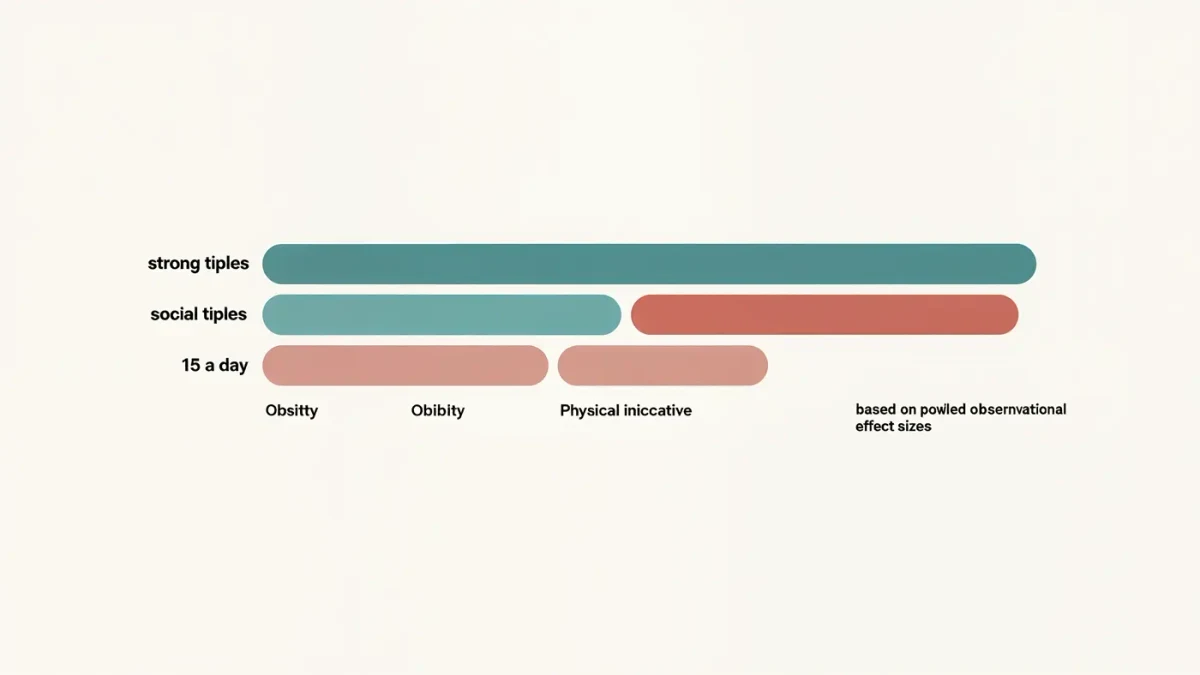
Strong social ties are linked to 50 percent higher odds of survival over the study periods examined, according to a meta-analysis of 148 studies with more than 300,000 participants published in PLoS Medicine in 2010 by Holt-Lunstad and colleagues — an effect size the authors put in the same territory as quitting smoking.
Loneliness itself is not a disease, but if it comes with persistent low mood, sleep problems, or loss of interest in life, those are worth raising with a doctor or mental-health professional.
How strong is the evidence, really?
The headline finding is the 2010 PLoS Medicine meta-analysis: across 148 studies and 308,849 participants followed for an average of 7.5 years, people with stronger social relationships had about 50 percent greater likelihood of survival than those with weaker ties. The association held across age, health status, and cause of death.
Holt-Lunstad's follow-up analysis in Perspectives on Psychological Science (2015) put the comparison that made headlines: loneliness, social isolation, and living alone were each associated with mortality risk on the order of smoking up to 15 cigarettes a day, exceeding the associations for obesity and physical inactivity in that dataset. In 2023, the U.S. Surgeon General issued an advisory on loneliness and isolation, citing the health stakes and noting that roughly half of American adults reported measurable loneliness even before the pandemic.
The usual caveat applies: observational studies show association, and healthier people may find it easier to socialize. But the dose-response pattern, consistency across dozens of cohorts, and plausible mechanisms — stress hormones, blood pressure, inflammation, health behaviors — make this one of the better-supported findings in behavioral research.
What is the difference between loneliness and isolation?
They are related but separate, and both matter. Isolation is objective: how few people you actually see and can call on. Loneliness is subjective: the gap between the connection you want and the connection you have. You can be isolated without feeling lonely, or lonely in a full house — and research suggests both states carry risk, through partly different pathways.
Practically, this means the fix is not always "meet more people." For the isolated, adding regular contact helps most: a standing weekly call, a recurring class, any commitment that puts people in your calendar. For the lonely despite contact, the work is usually depth — moving acquaintances toward friendships through repetition, openness, and time. Surveys such as the American Perspectives surveys by the Survey Center on American Life have found that friendship quality and frequency of real conversation predict well-being better than raw social-media contact counts, which tend to substitute poorly for in-person time.
How much connection is enough?
There is no RDA for friendship, but the research points to patterns rather than numbers. Studies that measure connection find benefits in:
- Frequency: regular contact — daily or near-daily interaction with someone, plus weekly meaningful contact beyond your household — recurs in the healthier cohorts.
- Quality: relationships marked by trust and support predict health; conflicted or draining ties predict worse outcomes, so not all contact is equal.
- Embedding: belonging to at least one group — a religious congregation, club, team, volunteer organization — shows up repeatedly in longevity research, including analyses of long-lived communities.
A practical benchmark many clinicians use: can you name two or three people you could call at 2 a.m. in a crisis, and do you see them, or anyone, at least weekly? If either answer is no, that is the useful signal — not to alarm you, but to give you a specific target.
What can one person actually do about it?
Connection research converges on a few moves that work better than vague intentions:
- Put it on the calendar. Recurring beats spontaneous. A standing Thursday walk with a neighbor survives busy weeks; "we should catch up soon" usually does not.
- Use repetition and proximity. Friendships form where you see the same people repeatedly — classes, volunteering shifts, hobby groups, dog parks. Choose anything you will attend weekly.
- Reach out first. Studies on the surprise of reconnection (Sandstrom and colleagues, published in Journal of Personality and Social Psychology, 2022) found people consistently underestimate how much friends and even strangers appreciate being contacted — the fear of awkwardness is inflated and the payoff is real.
- Layer it with health habits. Walking with a friend, group fitness classes, and community gardens stack connection onto exercise — two longevity levers in one hour.
None of this requires a personality transplant. Most of the measured benefits attach to structure — people you see on a schedule, in a group you belong to, doing something alongside others. Build the structure and the relationship follows.
Does this apply at every age?
Yes, with different failure modes. In midlife, careers and caregiving crowd out friendships gradually. After retirement, the workplace — for many people their main daily social structure — disappears overnight, which is one reason isolation risk climbs in the 70s. The National Institute on Aging highlights social activity as a component of healthy aging, and studies of older adults link engagement with lower rates of depression and cognitive decline. The principle is constant at every age: connection is a habit maintained on purpose, not a circumstance that takes care of itself.
Frequently asked questions
Is the "loneliness is as harmful as 15 cigarettes a day" claim literal?
No — it is a comparison of mortality-risk effect sizes across different studies, from Holt-Lunstad's 2015 analysis, meant to convey magnitude, not a mechanism. The accurate takeaway is that the association between isolation and early death is large enough that health bodies treat loneliness as a public-health issue.
Do online friendships count?
Partly. Contact that involves real conversation and existing relationships helps, especially for people who are geographically far from friends. Studies consistently find, though, that purely passive scrolling substitutes poorly, and in-person contact predicts well-being more strongly than screen-based contact alone.