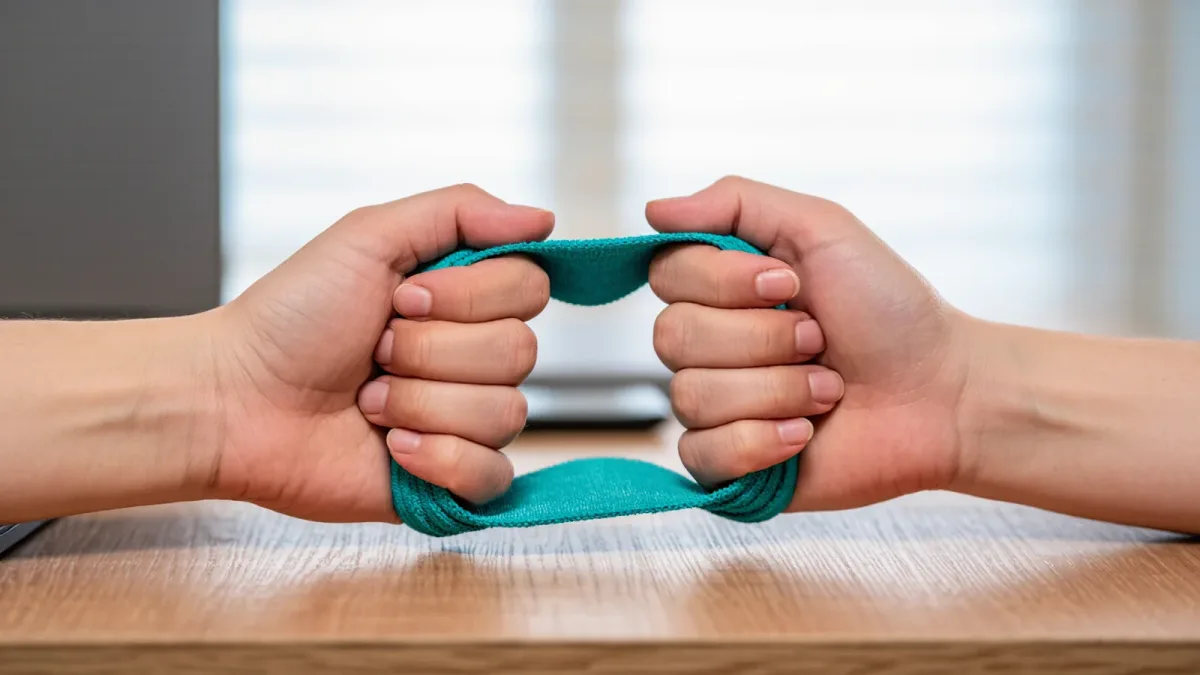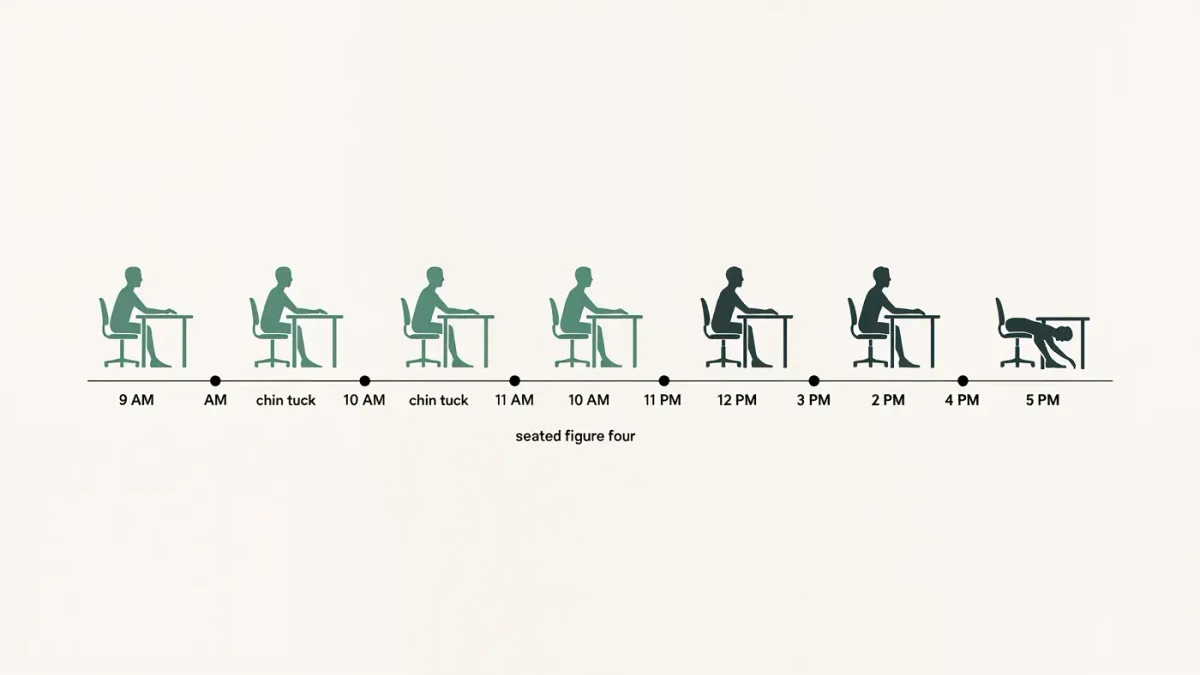
Six stretches, about 30 to 60 seconds each, cover the areas a desk day punishes most: neck, shoulders, chest, wrists, hips, and lower back. Ergonomics guidance from the Mayo Clinic recommends short movement breaks roughly every 30 to 60 minutes of sitting as of 2024, and these moves are built to be done in work clothes, at or beside your desk, without equipment.
Stretches should pull, never sting. If you have a disc injury, recent surgery, or pain that shoots down an arm or leg, check with a clinician or physical therapist before adding anything new.
Why do eight hours of sitting make everything ache?
Sitting is a static position, and muscles held in one position get stiff and sore over time. The exact mechanism is unglamorous: hip flexors shorten in a chair, the mid-back rounds forward over a keyboard, and the chest muscles adapt to that rounded posture while the muscles between the shoulder blades lengthen and weaken. The neck drifts ahead of the shoulders, and every inch of forward head position adds load on the cervical spine — a widely cited clinical estimate puts roughly 10 to 12 extra pounds of force on the neck for each inch of forward drift.
None of this means sitting is dangerous in itself. It means the body adapts to the position you give it most. Regular movement breaks and a handful of targeted stretches give it a different input.
What are the six stretches worth doing?
1. Chin tuck for the neck (30 seconds)
Sit tall, look straight ahead, and glide your head straight back so it makes a double chin. Hold five seconds, release, repeat five times. This reverses the forward-head position without yanking the neck sideways, which is why physical therapists consistently prefer it to rolling the neck in circles.
2. Shoulder blade squeeze for the upper back (30 seconds)
Draw your shoulder blades down and together as if pinching a pencil between them. Hold five seconds, relax, repeat five times. This wakes up the mid-back muscles that long typing sessions switch off, and it is invisible in a meeting if you keep your arms relaxed.
3. Doorway chest stretch (45 seconds per side)
Stand in a doorway, place a forearm on the frame with the elbow at shoulder height, and step forward until you feel a stretch across the chest. Hold 30 seconds each side. This opens exactly the tissue that hours of keyboard rounding shortens.
4. Wrist extensor stretch for typists (20 seconds per side)
Extend one arm, palm down, gently bend the wrist so the fingers point toward the floor, and press lightly with the other hand. Then repeat with fingers up, palm forward. Occupational health guidance for computer users typically recommends brief wrist and hand breaks throughout typing-heavy days; the United States Occupational Safety and Health Administration notes in its computer workstations guidance that periodic micro-breaks and stretching help reduce discomfort from repetitive keyboard work as of 2024.
5. Seated figure-four for the hips (30 seconds per side)
Sitting up, rest one ankle over the opposite knee and hinge forward from the hips with a flat back until you feel a stretch in the buttock and hip. Swap sides. This targets the deep hip rotators that chair time compresses and is the single most desk-friendly hip stretch there is.
6. Seated or standing back extension (30 seconds)
Place your hands on your lower back or on the back of your chair, and gently arch backward, looking slightly up. Hold three seconds, return, repeat five times. The opposite of a slouch, this is the move physiotherapists most often prescribe for desk-related lower back stiffness.
When should I stretch during the day?
Anchor the set to moments that already exist, or it will not survive a busy week:
- Two-move micro set, every hour: chin tucks plus shoulder blade squeezes, about one minute total. Calendar reminder or natural meeting breaks both work.
- Full six-move set, once a day: mid-afternoon, when stiffness peaks and the coffee run is stale. Roughly five minutes door to done.
- Doorway stretch on transitions: every time you pass through the kitchen or office door for water, one 30-second chest stretch. Boringly effective.
Per-30-to-60-minute movement breaks are the general ergonomics recommendation; the exact intervals matter less than breaking up unbroken sitting. If you can only keep one habit, keep the hourly micro set, because frequency beats duration for desk stiffness.
What if stretching hurts or does not help?
Stretch to mild tension, never to pain. Sharp pain, numbness, tingling, or symptoms running down an arm or leg are stop signs — those patterns need assessment, not more stretching. And if six weeks of consistent stretching changes nothing, the problem may be load rather than flexibility: a monitor raised to eye level, a chair that lets your feet rest flat, and a keyboard at elbow height often fix what stretches alone cannot. Mayo Clinic ergonomics guidance emphasizes exactly that pairing, with monitor top at or slightly below eye level and elbows close to the body at roughly 90 degrees.
FAQ
Will desk stretches fix my posture permanently?
Not on their own. Stretches relieve stiffness and restore range, but posture adapts to how you spend your hours, not to five minutes of correction. The combination that works is hourly movement breaks, one focused stretch set a day, and a workstation that stops forcing you into the rounded position in the first place. Think maintenance, not a one-time repair.
Is it better to stretch in the morning or at work?
For desk-related stiffness, stretching during the workday wins, because it interrupts the sitting that causes the problem. A morning routine is a fine addition if you enjoy it, but a 7 a.m. set does not offset eight unbroken chair hours. Spread the same moves across the day and they do more work.
Can I do these stretches discreetly in an open office?
Four of the six are invisible: chin tucks, shoulder blade squeezes, seated figure-four, and back extension in your chair all look like ordinary shifting or leaning back. Save the doorway chest stretch for a private moment, or swap it for clasping hands behind your back and lifting the chest, which reads as a regular sigh-and-reach.