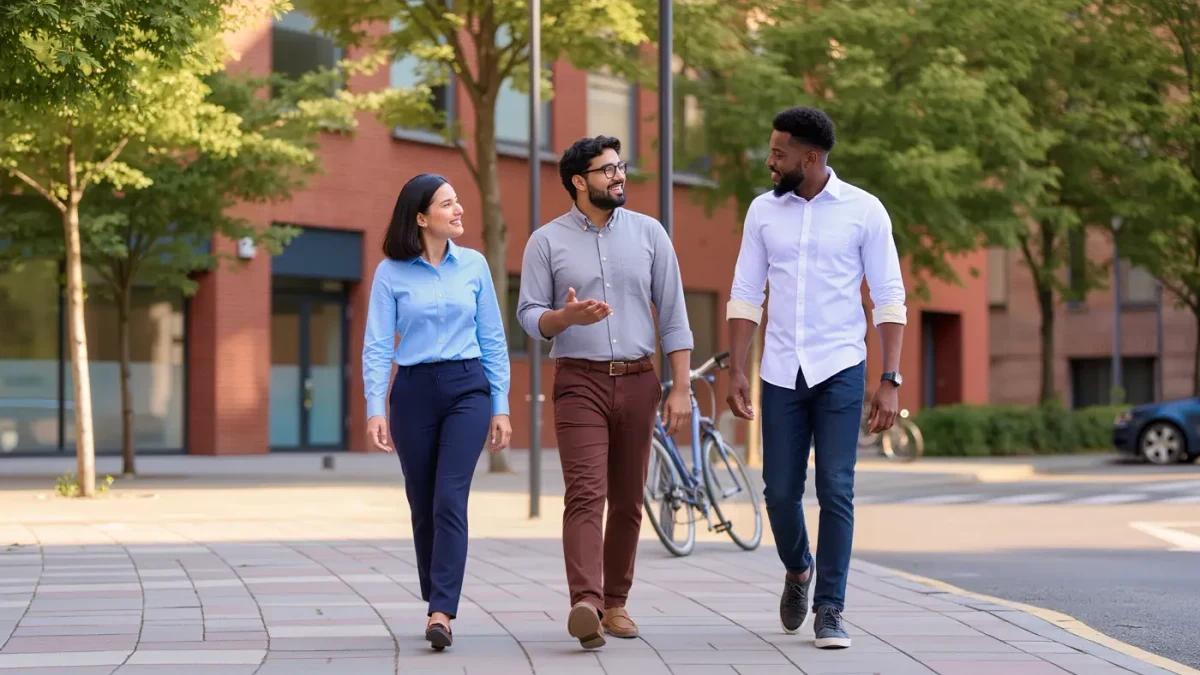
Swap one sit-down meeting a day for a walk and you can add 30 minutes of movement without working a minute longer — a 2015 study published in PLOS ONE found a workplace walking program raised participants' average workday activity by about 10 minutes and improved measures of work-related affect. One-to-ones, status updates, and brainstorming sessions all move well on foot. Here is how to make the switch stick.
Adding walking is low-risk for most people, but if you have a condition that affects mobility or balance, check with a qualified health professional first.
Why replace a meeting with a walk at all?
Because sedentary hours are where most desk workers lose the day. The CDC recommends 150 minutes of moderate activity per week, and short bouts count toward that total — brisk walking in 10-minute chunks adds up. Sitting for prolonged periods is associated with higher risks of cardiovascular problems, according to the American Heart Association's 2016 scientific statement on sedentary behavior.
There is a work case too. A 2014 Stanford study by Oppezzo and Schwartz found walking increased creative output by an average of about 60 percent on divergent-thinking tests compared with sitting. Not every task benefits — walking meetings suit conversation, not spreadsheets.
Which meetings work as walking meetings?
Pick meetings where talking is the whole job. Good candidates: one-to-ones with your manager or reports, recurring status check-ins, project kickoffs, and idea-generation sessions. Bad candidates: anything requiring screens, shared documents, note-taking on a laptop, or formal recording — negotiation reviews, design critiques, performance conversations with HR stakes.
A useful filter from a 2020 BBC reporting roundup on walking meetings: if the meeting ends with "I'll send it over," it probably needs a desk. If it ends with a decision and next steps you can capture in a voice memo, it walks.
How do I actually run a walking meeting?
Set the route and the rules before you leave. A 30-minute meeting needs a loop of roughly 2 to 2.5 miles at a conversational pace — test the loop once on your own so you know it ends back at the office on time. Tell attendees the format when you send the invite so no one shows up in heels expecting a boardroom, and suggest weather-appropriate shoes.
During the walk, keep it simple: one person records decisions in a phone note or voice memo, and nobody checks email mid-conversation. Agree at the start who captures next steps. If the group is larger than four, conversation fragments — split into pairs or cap the headcount.
What about weather, remote teams, and access?
Rain and remote colleagues are the two honest objections. For weather, keep an indoor fallback — a large corridor loop, a museum lobby, a shopping arcade, or a treadmill pair in a building gym. The walk matters more than the scenery.
For remote teams, the equivalent is the phone-call walk: both parties dial in from their own neighborhoods. This sidesteps the screen entirely, which many people find changes the tone of one-to-ones for the better — no shared-document staring, just conversation. Just agree in advance who takes notes.
How much movement does this actually add?
Roughly 2,500 to 4,000 extra steps per swapped meeting, depending on pace and loop length, which moves you visibly toward the widely cited 10,000-step benchmark. That benchmark began as a 1960s Japanese marketing figure, as the Smithsonian Magazine has documented, but the direction is right: in the 2023 analysis published in the European Journal of Preventive Cardiology, meta-analysis of studies found each additional 1,000 daily steps was associated with a meaningful reduction in all-cause mortality risk.
The honest framing: one walking meeting a day is not a fitness program. It is roughly 25 to 30 minutes of the CDC's weekly 150 minutes, five days a week — about half the target banked before you ever exercise on purpose.
Etiquette and small print
- Ask before you move someone's meeting. Some people have injuries, chronic pain, or caregiving constraints that make walking hard — offer the desk option every time.
- Match the pace to the slowest person. A walking meeting where half the group is breathless is a bad meeting.
- Keep phones away except for capturing notes. The point is undivided attention.
- Cap it at 45 minutes. Beyond that, pick a café table and finish seated.
Frequently asked questions
Do walking meetings actually work for productivity?
For conversational work, yes — the 2014 Stanford study found walking boosted creative idea generation by an average of about 60 percent versus sitting, and participants in the 2015 PLOS ONE workplace study reported improved work-related affect. The trade-off is that anything needing screens, precise figures, or formal notes stays at a desk. Use walks for talking, desks for deciding on details.
How long should a walking meeting be?
Keep the same length as the meeting it replaces — 25 to 30 minutes is the sweet spot, which allows a 2-to-2.5-mile loop at a conversational pace. Under 15 minutes works for quick check-ins on a short indoor route. Past 45 minutes, attention drifts and people need a seat.
What if my workplace culture would find it odd?
Start with your own one-to-ones and frame the invite plainly: "Fancy doing this one as a walk? Same time, we talk better moving." The 2015 PLOS ONE study ran exactly this kind of opt-in workplace program and found participants kept walking after it ended. Adoption spreads from visible, low-pressure examples, not policy memos.