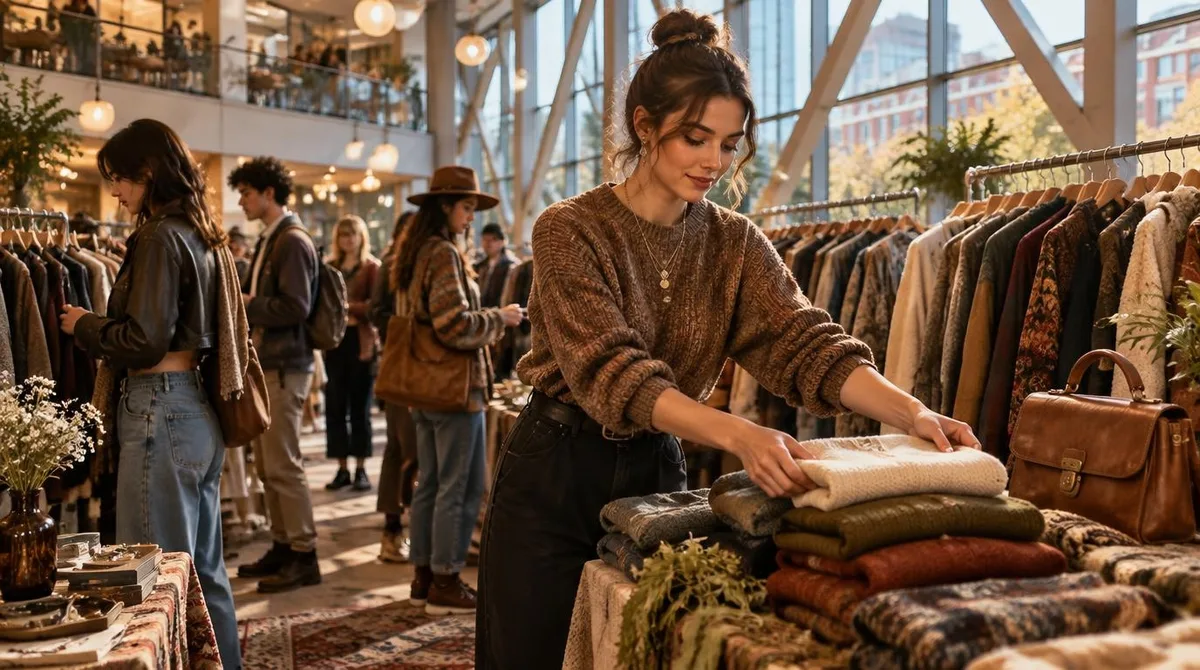
A swap event works when it is treated like a real marketplace, not a pile of clothes on a table. That is the lesson from Purdue, where the Fashion & Retail Organization hosted its annual Swap N' Shop on Oct. 17 at WALC, with 36 vendors and 430 buyers taking part. According to Purdue Exponent, the event is open to everyone and started about two and a half years ago.
The numbers alone say something about appetite. Four hundred thirty buyers showed up for one campus event. That is a crowd most resale platforms would envy, and it happened because the organizers gave people a reason to come in person: vendors, conversation, and a format built around sharing outfits rather than just selling them.
The practical takeaway is not that you need to replicate a university club. It is that the pieces FRO put together — a clear date, a defined vendor list, a community channel, and a bigger event on the calendar — are the same pieces that make any secondhand habit stick. Here is how to borrow them.
How do you actually organize a swap that works?
Start with the structure FRO used, which the Exponent's reporting lays out clearly. Any student vendor was invited, whether their business involved clothing or other goods. That openness is a design choice, not an accident. FRO President Elliana Cruz, a senior in business communication, framed the club's mission as including everyone, from people who like shopping or thrifting to those for whom clothes are a whole lifestyle. For related coverage, see Fashion Industry Business: Who Pays for Fashion News and What It Means for You.
The checklist that falls out of this is short:
- Fix one date and one venue. FRO used a single afternoon at WALC on Oct. 17.
- Invite vendors of any kind, not only clothing sellers. The Exponent notes the invitation extended to any student vendor selling clothing or other goods.
- Keep it open to everyone. The event has no gatekeeping requirement.
- Repeat it annually. This was the annual edition, and the event is about two and a half years old.
A swap that happens once is a party. A swap that happens every year becomes a habit, and habits are what keep clothes in circulation.
Why does a community channel matter more than the event itself?
Between events, the club runs on a GroupMe with over 1,000 members, where people share their outfits, and anyone can join through a link in the club's Instagram bio. "I would say our meetings are more event based and not necessarily like a general meeting," Vice President Amelia MacArthur, a senior in environmental science, told the Exponent.
That is the quiet engine of the whole thing. A chat where members post fit checks and talk about ways to shop sustainably keeps the secondhand mindset alive between swaps. For your own version, the step is simple: pick one channel, open it to anyone, and let the sharing be the point. The event is the punctuation, not the sentence.
What can a bigger show add to a wardrobe community?
FRO's largest event is the AURUM fashion show, held every April alongside the Purdue Photography Club and the Purdue Sewing and Design Club. The name comes from the Latin word for "gold." Every designer is a student and every worker is a volunteer. "They really put their hearts and souls into everything," Cruz said, describing how exciting it is to see the year's projects come together.
The structure matters for anyone building a wardrobe with intention. A show of student-made work puts construction, proportion, and fabric on display in a way that scrolling never does. You see what a garment looks like in motion, on a real person, made by someone who had to solve every seam. If there is a student show near you, go. If there is not, the next best step is the one FRO is planning now: a show-and-tell at the Rambler later in the semester, where anyone can bring a piece they collected and are proud of and talk about it.
How do you start your own version this month?
Work down the list from the top. Choose a date and a free space. Ask two or three friends to bring pieces they no longer wear. Open a group chat and post the first fit check yourself. Then put the next event on the calendar before the first one ends, the way FRO's executive team is already planning its show-and-tell at the Rambler.
The club itself has a history worth noting: it began as the Purdue Fashion Association, became Purdue Fashion Show, and has since merged with the Retail Organization into one club. Institutions, like wardrobes, get better the longer they are maintained. For more on how secondhand and resale fit into the wider retail picture, our fashion news coverage tracks the shifts that reach your closet and budget.
What does this mean for the clothes you already own?
The Swap N' Shop model rewards pieces with enough life left to change hands. That is a useful test before any purchase: would this garment survive a swap table? Checking fabric quality before you buy is where that starts, and our guide to cashmere quality shows what to look for in a sweater worth keeping. Fit is the other half of the test, and the Denim Fit Decoder breaks down rise, inseam, and leg opening so a secondhand pair can be judged on paper before you commit. This connects to our earlier piece, Denim Fit Decoder: Rise, Inseam, and Leg Opening Explained.
Purdue's students turned a swap into a fixture with 430 buyers in one afternoon. The method scales down to a dorm, an apartment, or a friend group. Pick the date, open the chat, and let the clothes keep moving.