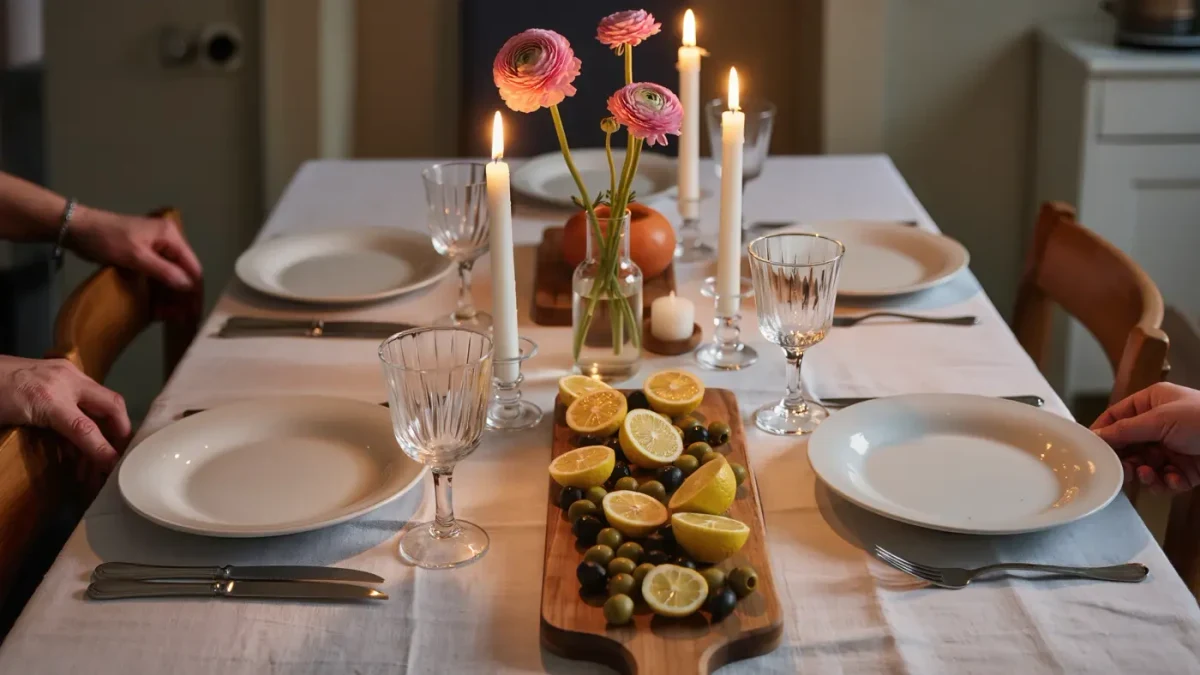
An easy, correct table setting takes about a minute per place: plate in the center, forks left, knife and spoon right, glasses above the knife, napkin left or on the plate. Add candles at or below eye level and a low centerpiece, and the table reads as considered — without a single specialized purchase or an afternoon of arranging.
What's the basic place setting?
Work outward-in and you can't go wrong. The dinner plate sits about an inch from the table edge, with the napkin to its left or laid on top. Forks go left (dinner fork outside, salad fork inside), knife and spoon to the right, knife blade facing the plate. Glasses sit above the knife — water glass first, wine beside it. Bread plate, if you're feeling formal, goes top-left with the butter knife across it. Dessert cutlery, when used, lies across the top of the plate: fork handle right, spoon handle left.
The only rule that matters for guests: they should never wonder which glass or fork is theirs. Bread plate on the left, drinks on the right — the old "b and d" trick (bread left, drinks right, forming the letters with your hands) settles every mid-dinner doubt. If you own mismatched cutlery, set it in matched pairs per position; eclectically matched looks intentional when each place is internally consistent. lifestyle coverage.
How do I set a table quickly before guests arrive?
Do it the night before, or at least before you start cooking — a set table is storage, momentum, and one entire task you don't do in the final frantic half hour. The 60-second-per-place routine: plate down, fork left, knife and spoon right, glass up-right, napkin last. Then the room, not the places: candlelight (the single highest-impact move in hosting — even grocery-store tapers transform a room), music at conversation volume, and the lighting taken down a third. Overhead lights off, lamps on.
Pre-stage the rest so dinner serves itself: water pitcher on the table, wine open and breathing if it's red, serving dishes with serving utensils already in them, and the salad or first course at least mentally assigned to a dish. A hosting rule worth adopting from restaurant people: nothing that requires you to leave the table more than twice should be on the menu. Cook what you can carry in two hands.
What do I do about the centerpiece?
The test is conversational: guests must see each other across it. Anything above roughly 12 inches or wider than the table's middle third is an obstacle, however beautiful. The fuss-free options that always work: three to five stems of one flower cut short in a low vessel, a row of small candles down the center, or a board — literally a wooden cutting board — with olives, nuts, and citrus. The board doubles as a pre-dinner snack station, which buys you the last ten minutes of cooking without guests hovering in the kitchen.
Unscented candles only at the table; scented ones fight the food. Tapers cost a few dollars a pair and burn three to six hours (as of 2026 retail, prices are subject to change), while tealights in groups of five or seven read as more deliberate than they cost. And whatever sits in the middle, keep it under forearm height — you're setting a table, not staging a window display.
How do I handle dietary needs and seating without stress?
Ask about restrictions when you invite — one line in the invitation text, not an interrogation at the door. Almost every restriction is absorbed by a menu with one big vegetable side and one sauce served separately, so plan a main that degrades gracefully: roast chicken and a grain salad feed nearly everyone; a stew with a dairy-heavy finish doesn't. Write the menu on a card or slate if any dish is unusual; guests relax when they know what they're eating.
Seating is a service, not a formality — place cards or just a deliberate "sit here" gesture from you at the start. Mix couples apart, seat shy guests next to talkative ones, and put yourself last in your own attention: the host's seat should let you get up easily. Name cards feel fancy and cost nothing but a pen; on a folded kraft card they look better than most expensive stationery.
And build yourself a graceful exit line for the kitchen: one honest sentence — "I'm going to finish the main, help yourselves to wine" — plus the snack board already on the table. Guests would rather pour their own wine from a pitcher you left out than watch you apologize for being absent. The whole easy-hosting philosophy is exactly that trade: five small preparations up front bought with a night-before table, in exchange for actually sitting down and joining your own party.
FAQ
Which side does the napkin go on?
Left of the forks is the classic placement, or folded on the plate for a simpler look. If space is tight, the napkin can go under the fork or on the bread plate. Any of these is correct — consistency across every place is what reads as polished.
Do I need a tablecloth?
No. A bare wood table with a linen runner looks better than a wrinkle-fighting cloth, and a good machine-washable runner costs $20–50 as of 2026 (prices are subject to change). If you do use a cloth, iron or steam it while barely damp; creases are the only thing that betrays a tablecloth.
How many courses should an easy dinner party have?
Two plus something with drinks: a snack when guests arrive, a main with sides, and one simple dessert. That's the maximum a solo host can serve while staying part of the conversation — and dessert can literally be good chocolate and clementines on the table you already set.