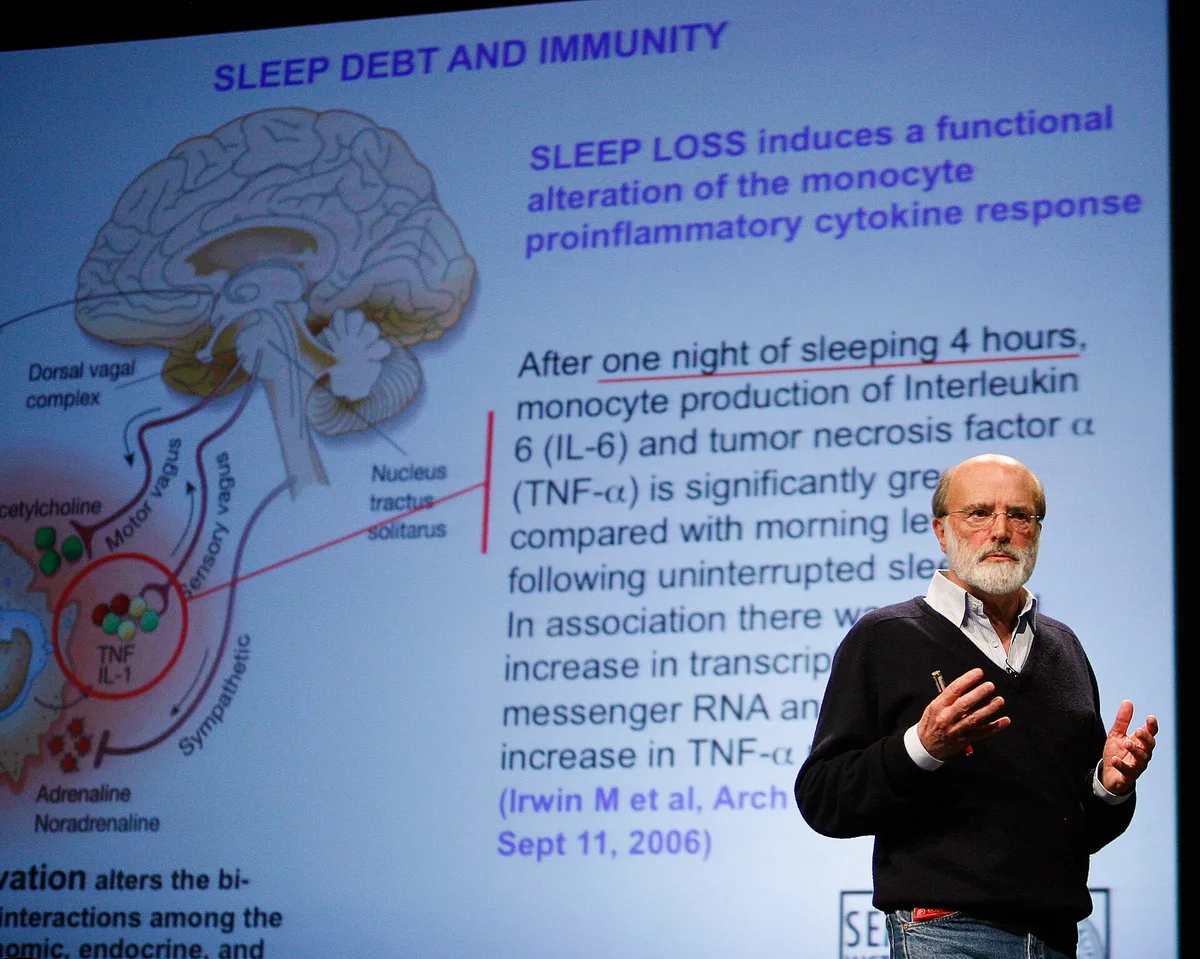
Weekend catch-up sleep restores daytime alertness reasonably well, but it does not undo everything: in a 2019 study of 36 adults published in Current Biology, two weekends of recovery sleep failed to reverse the insulin-sensitivity and weight-gain effects of five nights of restricted sleep during the week.
VOLEWO publishes information, not medical advice. If you regularly sleep seven or more hours in bed and still feel exhausted during the day, that pattern deserves a conversation with a doctor, since several treatable sleep disorders look exactly like ordinary sleep debt.
What is sleep debt?
Sleep debt is the gap between the sleep your body needs and the sleep you actually get. Most adults need seven or more hours per night, according to the National Heart, Lung, and Blood Institute and the American Academy of Sleep Medicine consensus from 2015. Sleep five hours on a weeknight and you owe your body roughly two hours that night — do it five nights running and the bill is sizable.
The most useful research on how this accumulates comes from a controlled study by Van Dongen and colleagues published in the journal Sleep in 2003: participants restricted to six hours per night for two weeks performed on reaction-time tests about as poorly as people kept awake all night once or twice — and, tellingly, they rated themselves as only mildly sleepy. Sleep debt builds quietly, and your own sense of it is not a reliable gauge.
Does sleeping in on weekends work?
Partially — and the distinction matters. On the alertness side, catch-up sleep genuinely helps. Studies of weekend recovery report improved reaction times and reduced daytime sleepiness, and people who sleep longer on free days feel sharper. If you slept six instead of eight hours all week, a Saturday morning to 9 a.m. will meaningfully repay the grogginess.
On the metabolic side, the picture is worse. The Current Biology study (Depner et al., 2019) put adults on five nights of five-hour sleep, then allowed weekend recovery sleep, then another week of restriction. The weekend sleepers regained some alertness, but their whole-body insulin sensitivity stayed reduced, they snacked more after dinner, and they gained weight — with the differences persisting even after a final recovery night. A smaller Danish study in the Journal of Sleep Research (2018) found that a weekend of extra sleep failed to erase changes in metabolic markers among young men after four nights of restriction.
One more wrinkle: late weekend mornings push your body clock later, so Sunday night you are not sleepy at bedtime and Monday starts with something close to jet lag — researchers call it social jet lag. The sleep-in strategy can quietly manufacture next week's debt.
How should you actually repay sleep?
Treat catch-up sleep as a tool with a short reach, not a weekly habit:
- Limit the lie-in. An extra hour, at most 90 minutes, past your weekday wake time. That repays real debt without shifting your body clock much.
- Nap early and short. A 20 to 30 minute nap before mid-afternoon adds sleep without stealing from the coming night. The National Sleep Foundation has recommended keeping naps in this range for exactly this reason.
- Go to bed earlier, not later out. If the week was brutal, a 9:30 p.m. bedtime on Friday is the recovery move that protects your Monday morning rhythm.
- Fix the weekday first. Debt repaid every night is debt never accumulated. The highest-leverage change for most people is a consistent wake time seven days a week — it anchors the whole schedule.
If a newborn, a demanding job, or shift work makes short weeks unavoidable, the calculus changes: research on shift workers suggests that when chronic restriction is unavoidable, regular longer recovery sleep is still worthwhile. Getting some catch-up beats getting none; the 2019 study argues for preventing the debt, not for abandoning recovery sleep once it exists.
How many nights until you're back to normal?
Longer than the weekend, in most estimates. Reaction-time and alertness research suggests one to two nights of recovery sleep restores how you feel, while studies tracking metabolic and cognitive measures after extended restriction show lingering effects for several days to a week. A practical rule after a hard stretch: protect a full week of seven-to-eight-hour nights before expecting your baseline back, and extend it if you accumulated several bad weeks. Persistence is the cue that something beyond ordinary debt — insomnia, sleep apnea, a thyroid issue — may be involved, which is a doctor conversation, not a sleep-in problem.
What about naps and early nights?
Both are quieter tools than the marathon lie-in, and they work with your body clock rather than against it. The National Sleep Foundation has long pointed to 20-to-30-minute naps before mid-afternoon as the sweet spot: enough to take the edge off sleepiness, short enough that you still build pressure for a full night. For the chronically shortchanged, the most reliable repayment method is simply an earlier bedtime for a week — seven nights of a ten o’clock bedtime beats one Saturday spent unconscious until noon, because every hour lands where your circadian rhythm expects it.
Environment does some of the work too. NHLBI guidance on healthy sleep emphasizes a dark, cool, quiet room and a consistent schedule as the foundation. Recovery plans fail most often not from lack of willpower but from phones, late caffeine, and irregular hours quietly trimming every night by another thirty minutes.
Frequently asked questions
Is sleep debt like a bank you can pay into?
The metaphor is only partly right. Alertness recovers like a balance, but some effects of restricted sleep — insulin sensitivity, appetite regulation — appear to lag behind, based on studies such as the 2019 Current Biology trial. Repay promptly and generously, but treat prevention as the real strategy.
Does napping count toward paying back sleep debt?
Yes, with timing rules. Short naps of 20 to 30 minutes before mid-afternoon add restorative sleep without interfering with the next night, while long or late naps often push bedtime back and create fresh debt. Early-evening dozing after a bad night is better replaced by an early bedtime.