Quiet luxury on a budget comes down to arithmetic, not money: buying roughly a third fewer pieces than you're used to, spending the savings on fabric and fit, and styling everything in a two-to-three color palette. A well-cut $70 wool-blend coat over a plain tee looks calmer — and richer — than five trend purchases fighting each other.
What does quiet luxury actually mean on a real budget?
It means the outfit gives you almost nothing to react to: no loud logos, no clashing prints, no fabric doing something cheap. You can build this look entirely from mid-price retailers — think Uniqlo, COS, Arket, J.Crew sales, and the occasional secondhand find — if you hold two standards from day one. First, the palette: camel, cream, charcoal, navy, chocolate, and one muted accent. Second, the fabric test: if it pills in the store photo, it will pill on you in a week.
The mistake most people make is treating quiet luxury as a shopping category. It's closer to an editing discipline. The woman who looks effortlessly expensive is usually wearing four plain things in matching tones, and the effect costs less than one It-bag. Prices at the retailers named here were checked in early 2026 and are subject to change, but the formula doesn't move with the seasons.
Which pieces are worth buying fewer but better?
Concentrate your budget where fabric touches skin and where construction shows: coats, knitwear, trousers, and shoes. Everything else — tees, tanks, scarves, belts — can be inexpensive as long as it stays in palette. A workable starting ratio: one great coat, two sweaters (one cream merino, one charcoal cashmere-blend), two pairs of tailored trousers, one pair of clean leather loafers or low boots, and plain tees to layer underneath.
Rough price bands as of January 2026: Uniqlo merino crewnecks around $30–50, their tailored trousers around $40–60, COS wool coats typically $250–450 on full price and less during their January sales, and quality secondhand cashmere from $25–60 on resale platforms. None of this is cheap, but it's a different order of money from the five-figure versions — and honestly, at ten feet, nobody can tell a $300 wool coat from a $3,000 one. Fit does that work for you.
The five-point fabric check
- Weight: hold it up. If it feels flimsy on the hanger, it will wrinkle and sag by lunch.
- Weave: look for tight, even knit or weave; loose loops pill and snag.
- Lining: coats and trousers with a real lining drape better and last years longer.
- Seams: gently pull a seam open — you should see no light through the stitching.
- Care label: if you'll never hand-wash it, don't buy it. Dead clothes are the most expensive clothes.
How do you style cheap pieces to look expensive?
Three habits do most of the work. First, tone-on-tone dressing: cream over oatmeal over ivory, or charcoal with slate. Monochrome lengthens you and hides the price tags. Second, keep every hem intentional — trousers just kissing the shoe, sleeves hitting the wrist bone, sweaters no longer than your hip. A $6 tailor visit for a hem transforms a $40 pair of pants; most dry cleaners charge under $20 to take in or shorten trousers as of 2026.
Third, subtract accessories instead of adding them. One structured bag in a neutral, small metal earrings, a watch. If your outfit feels like it's trying, it looks less expensive, not more. Steaming is the final free upgrade: wrinkles read as carelessness, and a $40 hand steamer used for ninety seconds makes even a cotton tee look deliberate. Prices are subject to change, but steamers have been in that range for years.
How many pieces do you actually need?
Fewer than you think — around 25 to 30 items covers a full real-life wardrobe for most climates, organized as coats and jackets (4–5), knitwear (5), trousers and skirts (5–6), dresses (2–3), tops (7), and shoes (4). The discipline that makes it work is the one-in-one-out rule: nothing new enters unless something leaves, and the new piece must pair with at least three things you already own.
Buy on a list, not on a mood. Keep a note on your phone titled "gaps" — "camel coat, wool, knee-length" — and only shop from it. This is the single behavioral change that separates people whose wardrobes compound in value from people whose closets stay full and unsatisfying. Sale sections only count when the item is already on your list; a discounted piece you don't need is still clutter, just cheaper clutter.
Does buying less really save money?
Yes, and faster than you'd expect. If you typically buy four $80 impulse pieces a month, that's roughly $3,800 a year on things that mostly go unworn. Reallocating even half of it to six genuinely good pieces — a coat, two sweaters, trousers, shoes — leaves you with a wardrobe that still works in five years, while the impulse pile would have pilled out by year two. The savings show up in maintenance, too: fewer items means less laundry, less dry cleaning, less decision fatigue every morning.
Give yourself a quarterly review instead of a monthly haul. Thirty minutes every three months: repair what's worth repairing, resell or donate what you haven't worn, and update the gaps list. The wardrobe stays current without the constant spending — and each review reminds you how little you actually needed.
FAQ
Is quiet luxury just beige minimalism?
No — the palette matters less than the calm. You can do the same logic in deep greens and burgundies; what defines the look is the absence of logos, the consistent tones, and fabrics with weight and texture. If color is your thing, keep it muted and keep the rest of the outfit plain.
Can I do this without any designer pieces?
Absolutely. The look relies on fit, palette, and fabric condition, none of which require a single designer label. Most people scoring the look best on a budget are wearing entirely mid-price brands plus secondhand cashmere. Spend on the coat and shoes first; everything else can wait.
What's the first piece to upgrade?
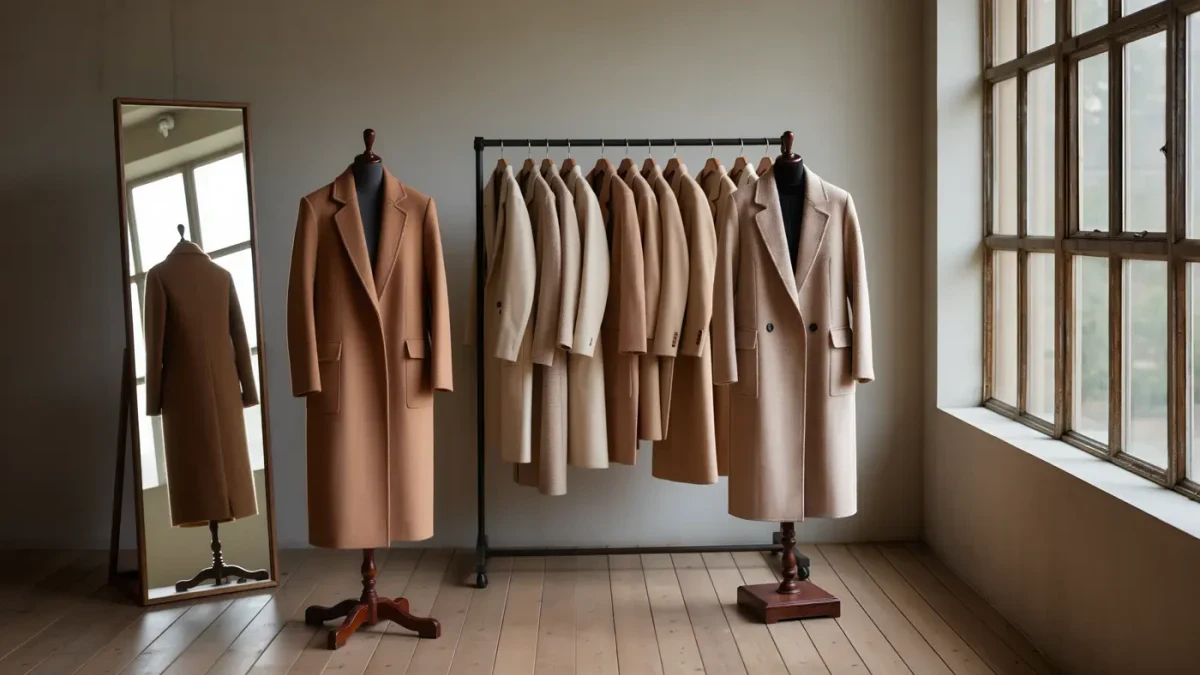
Your outerwear. It's the only thing everyone sees every day in cold months, and a well-cut coat in camel, charcoal, or navy quietly pulls your entire cheaper wardrobe up with it. Save through one season if you need to — a $250–400 wool coat as of early 2026 outlasts four fast-fashion versions at the same total cost.