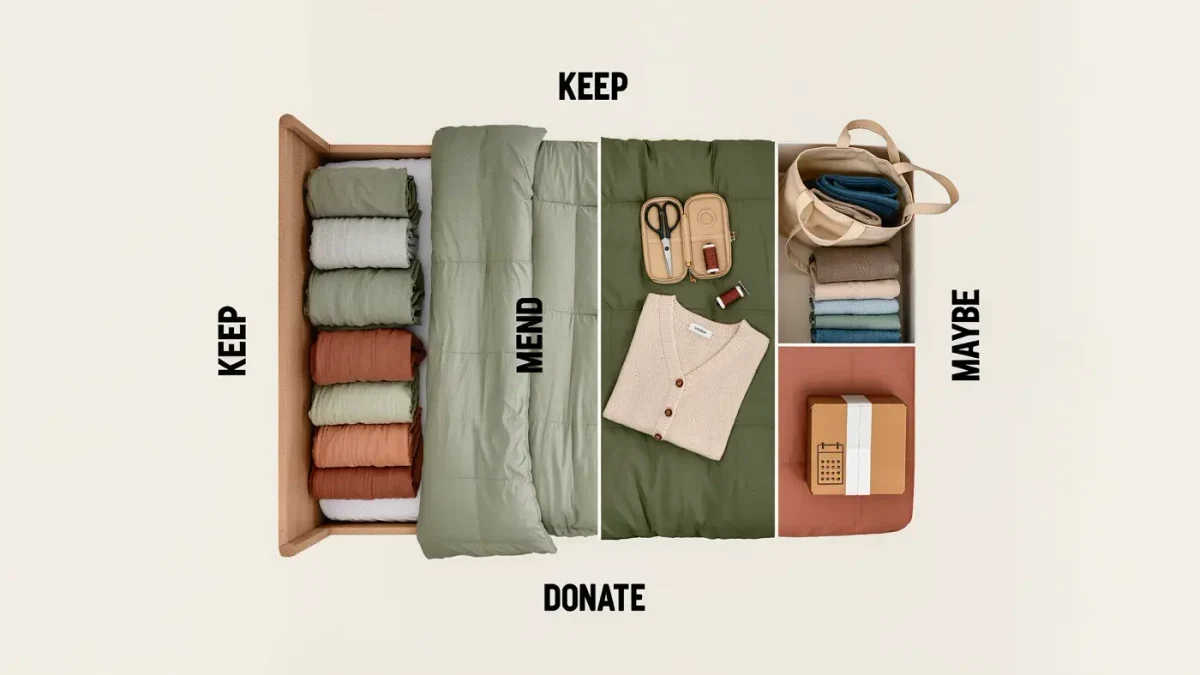
The four-pile closet edit sorts every single item into Keep, Mend, Donate, or Maybe — no fifth category, no "display on a chair while I decide." Pulled from the hanger and handled once, a normal wardrobe takes about two to three hours to sort; the Maybe pile is capped at one box, which is what stops the edit from stalling out at hour one.
How does the four-pile method work?
You take everything out — yes, everything, because the clothes hiding in the back are the ones you're deciding around — and touch each item exactly once, assigning it to a pile on the bed: Keep (worn in the last year and still liked), Mend (good piece, fixable flaw: loose button, dropped hem, stubborn zipper), Donate (fine condition, not your life anymore), Maybe (everything your hands hesitate over). The hesitation pile is the whole design; the method assumes you'll be ambivalent about a third of your closet and builds a container for it instead of letting ambivalence stop the process.
The discipline is in the single-touch rule. Items don't get to move between piles three times; a decision per garment, then on to the next. Put on music, keep water nearby, and work by category — all sweaters, then all trousers — because comparing like with like makes decisions dramatically faster than comparing a cocktail dress to a gym shirt.
What goes in the Maybe pile — and for how long?
The Maybe box gets one rule and one deadline. The rule: it holds a maximum of one medium box, so it can't quietly become a second closet. The deadline: seal it, date it, and store it out of the bedroom — under a bed, a top shelf, anywhere you don't open it daily. If twelve months pass without once needing something from that box, donate it unopened; the seal intact means the decision has been made by your actual behavior, not your intentions.
The classic test for borderline pieces is sharper than "do I love it?" Ask instead: would I buy this again today at full price? Would I pack it for a trip tomorrow? Have I worn it in the last twelve months — and if not, is that circumstance likely to return? Formalwear and truly seasonal items get leniency here; the cocktail dress worn once a year earns its hanger. The blazer from a job you left in 2022 does not.
Where does the Donate pile actually go?
Have the destination decided before you start, because a full donate bag that sits by the door for two months will leak items back into your closet. Options that actually take clothing: charity thrift stores, some municipal textile-collection programs, and donation bins run by named charities. For worn-out items beyond donation, textile recycling is the right stream — the U.S. Environmental Protection Agency notes that textile waste is a growing part of landfill, and many municipalities now run textile drop-off days. Anything stained beyond rescue or torn becomes a rag; that still counts as a good exit.
What belongs in the Mend pile?
Only items you'd wear within a month of fixing. The Mend pile's failure mode is becoming a guilt shelf — the jeans waiting two years for a $10 hem. So cap it mentally at five items and assign each a real deadline: buttons and hems can go to a tailor or dry cleaner for $5–20 per job as of early 2026 (prices are subject to change), and a small sewing kit at home covers the rest. Anything that needs serious alteration money — more than a third of what replacement would cost — gets honest re-sorting into Donate.
One exception worth funding properly: shoes and coats. Resoling a good pair ($60–120 at a cobbler as of early 2026) or replacing a coat's lining is nearly always cheaper than equivalent quality new, and these are the garments where the repair shows zero and the wear shows none.
How do I stop the closet from refilling?
The edit is the half of the job; the refill guard is the other half. After sorting, hang everything back with hangers reversed. When you wear something and re-hang it, reverse the hanger the right way. In twelve months you'll see — without any app or effort — exactly which hangers never flipped, and the next edit takes twenty minutes instead of three hours. That's the quiet genius of a physical system: your wardrobe tracks itself.
Pair the edit with a shopping rule so the empty space doesn't refill by default: the one-in-one-out rule for a season, plus a running note on your phone listing genuine gaps. Buy from the list, not from a mood or a sale email. Wardrobes drift full again because entering is frictionless and exiting is emotional; the four-pile edit makes exiting procedural once a year — and after that first honest pass, each annual edit gets shorter, gentler, and weirdly satisfying.
FAQ
How long should a four-pile closet edit take?
Two to three hours for a full wardrobe, done once properly; the category-by-category approach keeps decisions fast. After the first edit, annual maintenance passes run 20–40 minutes because the reversed-hanger trick has already done the sorting for you.
What if almost everything ends up in Maybe?
Then the box cap is doing its job — one box only, and the overflow goes to Donate. Ambivalence at scale usually means decision fatigue, not attachment: take a break, come back, and use the "would I rebuy it today?" question. The calendar will settle what your tired brain can't.
Is it okay to sell instead of donate?
For current-condition branded pieces, resale platforms can return $10–50 an item, as of early 2026 marketplace norms — but price honestly and set a two-week deadline, or the selling pile becomes the new clutter. Everything else donates. The edit's real return is closet clarity, not the cash.