A comfortable evening room runs on three layers of light: ambient (the soft base that fills the room), task (bright, focused light for reading, cooking, and desk work), and accent (the low glow that gives a room depth). Most homes rely on a single ceiling fixture for all three jobs — and that's exactly why the room feels like a waiting room after sunset.
What are the three layers of lighting?
Ambient is the general light that lets you walk through the room without an obstacle course: floor lamps with fabric shades, uplights, dimmed ceiling fixtures. Task is the hard worker — a reading lamp beside the sofa, under-cabinet strips in the kitchen, a desk lamp. Accent is atmosphere and dimension: a small lamp on a bookshelf, a candle, a picture light, a string of bulbs outlining a shelf. Each layer switches on independently, which is the entire trick.
The why is simple physics and human wiring. One bright overhead source casts a single pool of hard shadow, and evening eyes read that as institutional. Three or four lower sources at different heights — roughly chest height and below by evening — create overlapping pools of soft light with gentle shadows in between. That shadow variation is what people perceive as "cozy." It costs almost nothing to add: most homes already own the lamps; they're just not distributed or dimmed thoughtfully. lifestyle coverage.
How do you build the ambient layer?
Start by demoting the ceiling light. In the living room and bedroom, make it the last resort — for finding a lost earring, not for existing under. Your replacement ambient sources: two floor or table lamps placed at opposite ends of the room so their pools overlap, both with warm bulbs. Aim for the light source itself sitting at or below eye level when you're seated; a shade that hides the bulb from a seated sightline is doing its job.
Bulb language worth learning, since it does more than the lamp body: for evening, choose 2700K or lower (labeled "warm white" or "soft white"), brightness around 450–800 lumens per lamp, and if possible a dimmable bulb. As of early 2026, warm-dimmable LED bulbs run about $3–10 each at hardware stores, and a plug-in dimmer for a lamp without one costs $15–25. Prices are subject to change, but LEDs keep getting cheaper, not dearer. One habit to steal from hotels: light the room's corners. Corners eat darkness; a lamp there makes the whole room feel finished.
The task layer, room by room
- Sofa: an adjustable reading floor lamp or swing-arm table lamp; the light should land on the page, about beside and slightly behind your shoulder.
- Kitchen: under-cabinet LED strips or puck lights for counters, so you're not working in your own shadow under the ceiling fixture.
- Desk: a lamp with a narrow, directed beam; position it opposite your writing hand to kill the shadow on your notebook.
- Bedroom: two small bedside lamps at shoulder height when sitting up, so reading doesn't wake the whole bed.
- Bathroom: if late-night trips are the issue, a dim night-light beats flipping on 900 lumens at 3 a.m.
What belongs in the accent layer?
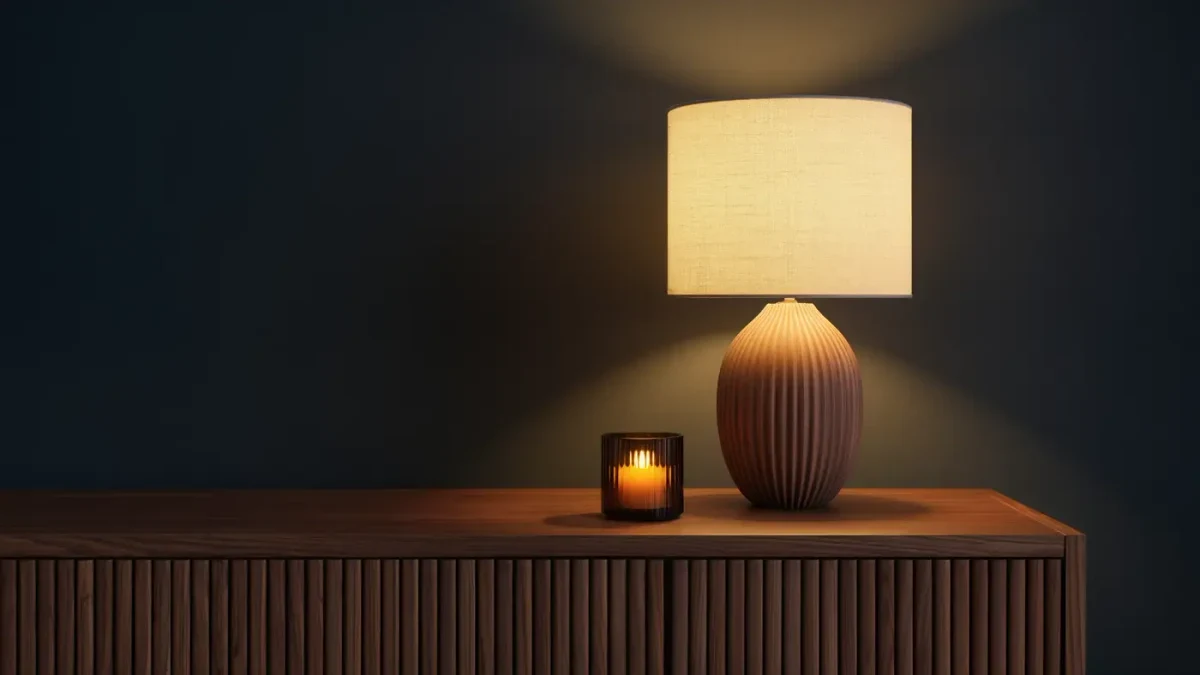
Anything whose job is glow rather than work. The highest impact-per-dollar pieces: a small 8–12 inch table lamp on a bookshelf or sideboard, a candle (real or LED) for the darkest corner, and plug-in dimmer cords for table lamps so you can take them from "functional" to "flicker" after dinner. Battery picture lights have also come down in price — decent ones run $25–60 as of early 2026 — and they make even inexpensive framed prints look collected.
The accent layer is also where color temperature gets playful. A slightly warmer bulb (2200–2400K, sold as "vintage" or "amber" style) in shelf lamps gives that candle-lit depth without making the room unusable. Keep accent lights on the edges and heights of the room — shelves, mantels, window ledges — so your eye travels around the space instead of pooling in one spot.
How much should this whole project cost?
Surprisingly little if you audit before you shop. A weekend plan: pull every lamp you own into the living room, buy warm 2700K bulbs for all of them (often under $30 total), add one plug-in dimmer, and move your best reading lamp beside the sofa. That alone transforms most rooms for under $60, as of early 2026 retail. Then buy deliberately: one good floor lamp ($60–150) beats three cheap ones, and secondhand lamp bodies plus new shades and wiring kits are a quiet bargain — a $15 thrift lamp with a $20 new shade and a fresh cord looks like a $120 piece.
The only genuinely worthwhile splurge is dimmers. Dimming is what lets one room be an office at six and a lounge at nine. If full wall-dimmer installation is out of reach, plug-in dimmers on every table lamp get you 80 percent of the effect for a fraction of the cost.
FAQ
What color bulb is best for evening?
2700K or lower — anything labeled warm white, soft white, or vintage. Save 3000K and above for closets, laundry rooms, and garages. If a room feels clinical despite good lamps, the bulb temperature is almost always the culprit, not the lamps.
How many lamps does a living room need?
Three to four light sources minimum for an average room: two ambient lamps at opposite ends, one reading lamp, and one small accent light on a shelf or sideboard. Distribute heights — floor, table, shelf — so the light builds in layers rather than in one plane.
Are smart bulbs worth it for lighting layers?
They're convenient, not essential. Their real benefit is scheduling and dimming without new wiring; warm-dimmable smart bulbs start around $10–15 each as of early 2026. If budget is tight, plain warm dimmable LEDs plus plug-in dimmers deliver the same evening feel for less.