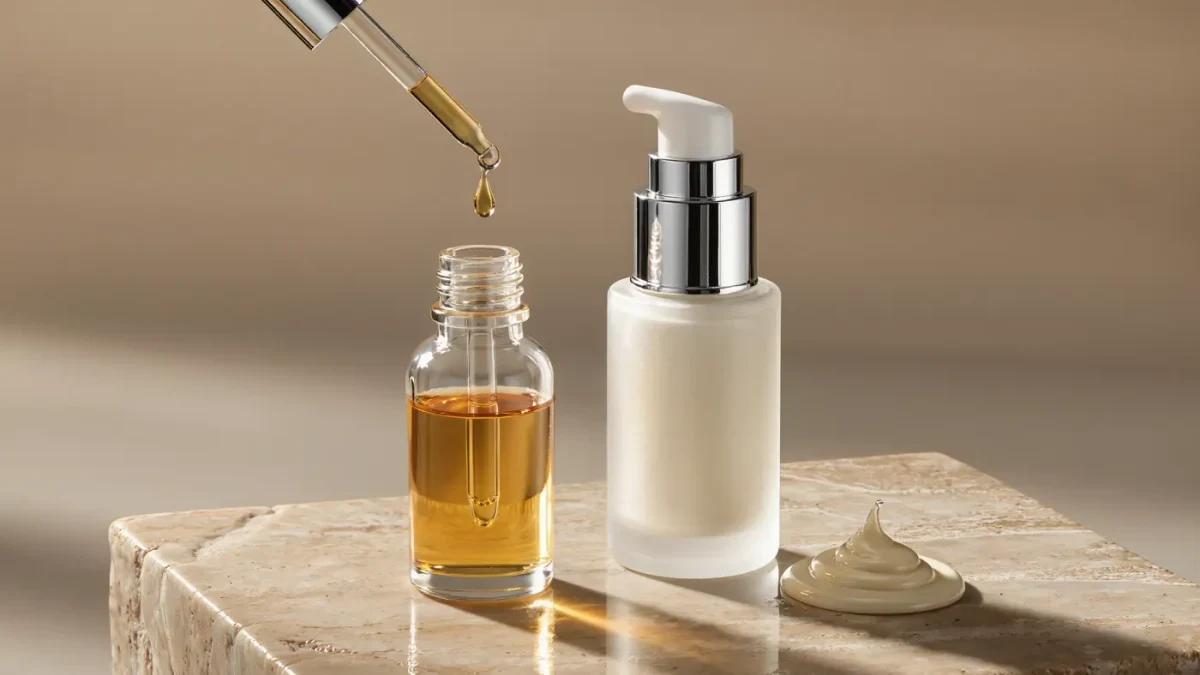
A hair oil conditions and seals moisture into the hair shaft, while a hair serum smooths the cuticle, adds slip, and mostly protects from heat, humidity, and friction — which is why oil belongs before or after washing as a treatment, and serum belongs on dry or damp hair as a finishing step. The distinction comes down to formulation: oils are single or blended lipids like argan, coconut, or jojoba, while serums are typically silicone-based (dimethicone and its relatives appear in most major serum formulas per their INCI lists). Lipids nourish; silicones coat. Both have a job. They just are not the same job.
VOLEWO publishes information, not medical or skincare advice. If you are dealing with scalp conditions, sudden shedding, or persistent flaking, a dermatologist is the right first stop. The rundown below reflects cosmetic chemistry and trichology sources as of 2026.
What does hair oil actually do?
Two things: reduce protein loss and soften. A frequently cited 2003 study published in the Journal of Cosmetic Science found that coconut oil, applied before or after washing, penetrated the hair shaft and reduced protein loss noticeably more than mineral oil, thanks to its structure. Plant oils with small enough molecules — coconut, and per later research in the same field, oils like sunflower in specific contexts — can get inside the strand, while larger-molecule oils mostly sit on the surface. Either way, oil coats the cuticle, which cuts down friction between strands. Less friction means fewer broken hairs when you brush, sleep, or pull your hair into a ponytail. Oil is a conditioner in the truest sense: it improves the condition of what is already there.
What does hair serum actually do?
It makes hair look and behave better immediately, mostly by coating the outer cuticle with silicones. Dimethicone and amodimethicone flatten the cuticle's raised edges, which is what creates that glassy, just-blown-out reflection, and they form a light film that blocks some humidity — frizz is hair absorbing moisture from damp air, and a silicone film slows that exchange. Many serums also add heat protection; per the documentation of most thermal protectant brands, silicone films help distribute heat more evenly across the strand, though they do not make heat harmless. Serum changes how hair behaves today. It does not change the hair's condition over time.
When should you use oil instead of serum?
Reach for oil when the problem is dryness and breakage; reach for serum when the problem is frizz, dullness, or flyaways on a given day. In practice:
- Pre-wash oiling: 20 to 30 minutes before shampooing, oil protects the strand from being over-stripped — the timing from the protein-loss research, which found pre-wash application especially effective.
- Post-wash sealing: two or three drops on damp mid-lengths and ends lock in the water your conditioner just delivered.
- Overnight treatment: a light oiling before a silk pillowcase night, shampooed out in the morning.
- Never before heat styling: cooking oil on a hot strand damages the cuticle — this is a serum-with-heat-protection moment, or better, no oil at all.
Can you use both, and in what order?
Yes, and the order is oil first, serum last. The classic pairing for coarse or curly hair: pre-wash oil treatment, shampoo and condition, then a drop of serum on damp ends before air-drying or blow-drying, and one more drop smoothed over dry hair as a finish. What you should not do is layer serum under oil on the same day at the same spot — the oil can disrupt the silicone film, leaving hair looking greasy rather than glossy. If your hair is fine or gets limp easily, choose one: serum alone for shine, or a single drop of oil on the ends only.
How do you keep it from going greasy?
Application zone and quantity decide everything. Mid-lengths and ends only — never the roots or scalp unless the product is explicitly a scalp oil, because sebum from your own scalp is already conditioning the first few inches. For a full head of medium-length hair, three to four drops of oil or one pump of serum is the honest ceiling; warm the product between your palms and rake it through with fingers, then smooth the surface with a brush. Start with less than you think you need. Adding a drop is easy; washing out an over-oiled head means another shampoo day, and every extra wash strips what you were trying to protect.
Do silicones in serums build up and damage hair?
Some do, some do not, and buildup is manageable. Cosmetic chemistry literature distinguishes between silicones like dimethicone, which can accumulate with repeated use and require a clarifying shampoo occasionally, and amodimethicone, which is engineered to deposit selectively on damaged areas and self-limit. Buildup is not damage — hair looks flat or coated until it is clarified, then returns to normal. If you use a silicone serum several times a week, a clarifying wash roughly once every two to three weeks keeps things balanced. Water-soluble silicone alternatives exist too, if you prefer to avoid the ritual entirely.
FAQ
Is oil better for hair growth? No oil has been shown to grow hair on a bald scalp. What oils improve is retention: by reducing friction and breakage, hair that would have snapped off stays on your head, which reads as longer hair over months. True growth concerns — thinning, shedding, patchiness — belong with a dermatologist, who can evaluate treatments with actual evidence behind them.
Which one is right for curly hair? Usually both, in different roles. Curls tend toward dryness because scalp oil travels down the strand less easily, so a pre-wash or sealing oil addresses moisture, while a lightweight serum on wash day defines the curl pattern and blocks humidity. Heavier oils work well for thick curls; fine waves should stick to a few drops of serum.
Can I use hair oil on my scalp? Only if the product is formulated for it. Scalp oils exist and some, like those with rosemary oil, have small studies behind them — a frequently cited 2015 trial in SKINmed found rosemary oil comparable to minoxidil 2% after six months, though the study was modest in size. Regular cosmetic hair oil on the scalp mostly just requires more washing.