The word long-wear promises exactly what it says. According to Dictionary.com, "long" in its most relevant sense means "having considerable duration in time" — and a long wear lipstick is formulated to hold its color for hours rather than minutes. The catch is that not every tube labeled long-wear gets there the same way, and the formula you choose matters as much as the application.
The short version: matte and transfer-proof formulas last longest but feel driest; tinted balms and stains feel best but fade fastest; and prep — exfoliated, balm-blotted, liner-anchored lips — is what keeps any of them intact through a meal. If you have ever looked in a mirror at 2 p.m. and found only a ring of crumbs around your lip line, the problem is usually one of those three steps, not the lipstick itself. This connects to our earlier piece, The Three-Minute Face: A Minimal Makeup Routine That Still Looks Finished.
This guide walks through how the main formula families differ, how to prep lips so color has something to grip, and the application order that keeps edges crisp. Pair it with our lip liner guide for the liner step, and with beauty coverage here for the rest of a low-maintenance routine.
Which formula actually lasts the longest?
Matte liquid lipsticks are the endurance champions of the category. They set down fully, bind pigment to the lip surface, and generally survive a sandwich. The trade-off is comfort: many feel tightening, and very dry formulas can settle into lip lines and flake. If your priority is a color that does not move, matte is the honest answer.
Transfer-proof or "kiss-proof" bullets sit in the middle. They resist cups and cheeks better than a cream lipstick but usually leave some pigment on glass. Traditional cream and satin finishes are the shortest-lived; they are comfortable and easy to refresh but will not outlast coffee. Tinted balms and stains work differently — a stain dyes the lip itself, so it fades evenly instead of breaking up into patches, even though the color is softer. For related coverage, see The Drugstore Moisturizer Ingredients That Actually Do the Work.
A practical rule: match the formula to the day. A stain or tinted balm suits a morning of errands where touch-ups are easy. A matte liquid suits a long event or a workday when you will not get near a mirror. Nothing needs to survive everything, and pretending one tube will is how drawers fill with disappointments.
Does prep really change how long lipstick lasts?
Yes, and it is the step most people skip. Long-wear formulas cling to smooth, dry-ish surfaces. Flaky or balm-slicked lips give pigment nothing to hold, which is why color slides off in patches by midday. Prep takes about two minutes.
- Exfoliate gently — a washcloth in small circles or a sugar scrub once or twice a week. Daily scrubbing irritates.
- Apply a thin layer of lip balm while you do the rest of your makeup.
- Right before lipstick, blot the balm off with a tissue. You want lips conditioned, not coated.
- If lips are chronically dry, treat it overnight rather than piling on product in the morning. Our piece on moisturizer ingredients that actually do the work covers the barrier-repair staples worth looking for.
What this means in practice: the blot is the step people miss. Balm under long-wear lipstick is the most common reason a supposedly transfer-proof formula suddenly isn't.
What is the right way to apply long-wear lipstick?
Thin layers beat thick ones, every time. A thick coat takes longer to set, moves while it sets, and is far more likely to crack. Apply, press lips together once, blot, and repeat once if you want more depth. Two thin layers outlast one generous one.
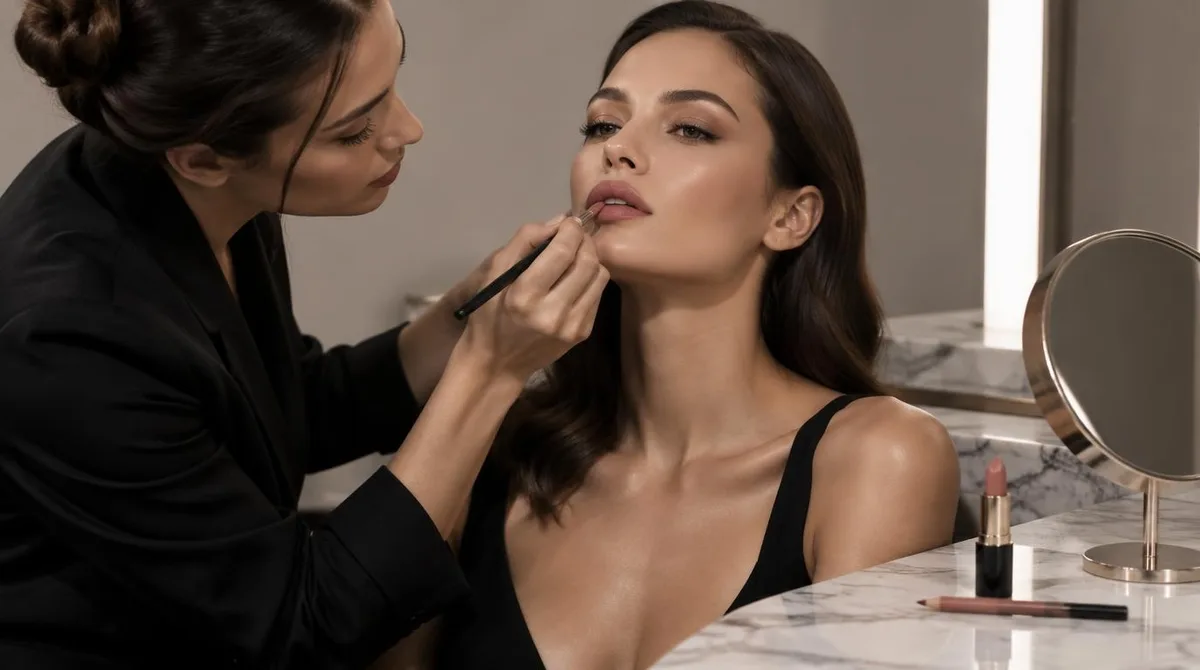
Order matters too. Liner first, drawn slightly inside the natural line and used to fill the whole lip, gives matte formulas an anchor and stops the feathering that makes edges look crumbly. If you are using a liquid matte, work in the center of the lip and drag outward with the applicator's edge rather than pressing straight down. Let it set undisturbed for a minute before you talk, sip, or smile at anyone.
One more trick that costs nothing: after blotting the final layer, press a fingertip of translucent powder over a tissue laid on the lips. The tissue keeps the powder from dulling the color while the powder dries the surface. It is an old makeup-artist move precisely because it works with almost any formula.
How do you keep lipstick on through meals and coffee?
Some losses are physics. Anything oily — salad dressing, fries, butter-based sauces — dissolves most pigment, including long-wear formulas. You can outsmart it a little: blot food with a napkin before a bite rather than wiping, use a straw for iced drinks, and take hot coffee in sips from the same spot on the rim rather than gulping. Small habits, real difference.
Expect honest wear, not magic. A good matte liquid should still be mostly there after lunch, with the inner edge faded and needing a quick touch. A stain will look softer but even. If a formula is gone entirely by mid-morning, the issue is nearly always prep or layer thickness — go back two sections before you blame the tube.
For touch-ups, carry the same product rather than piling new layers over crumbled old ones. Blot first, then reapply a thin coat. If the edges have gone ragged, a clean liner pass resets the line faster than a full do-over.
Our analysis: the two-step that matters most
If you change only two things, blot the balm and go thin. Those two steps fix the majority of long-wear failures — the patchy fade, the crumb ring, the color that transfers onto every cup. Formula choice then becomes a comfort decision instead of a durability gamble, and that is the version of long wear lipstick that actually fits a real day: color you stop thinking about by nine a.m., still quietly there at dinner.
A last note on comfort. Long-wear formulas are drying by design, so end the day with real balm, not a wipe-and-forget. Lips tolerate a matte day far better when they are conditioned overnight — the same principle behind the layering order in our skincare routine guide, scaled down to a two-inch stretch of skin.