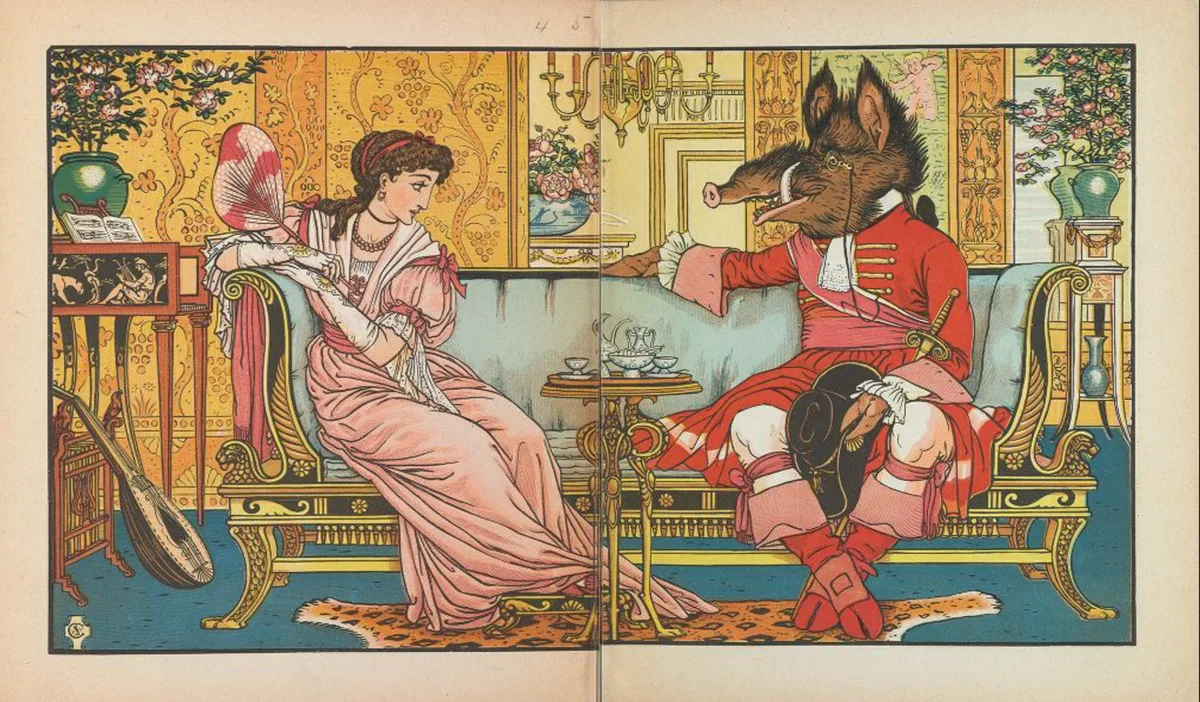
Beauty and the Beast keeps getting retold because it asks a question every generation wants to answer again: what makes someone worth loving, and what makes something beautiful? The plot never changes much. A young woman trades her freedom for her family. A cursed creature hides behind walls. She reads books; he learns manners. Yet each new version — on stage, on screen, in books — reshapes the answer to fit its moment.
The tale has deep French literary roots, and storytellers have been reworking it almost since it first appeared in print. That is the sign of a strong skeleton. A story that survives centuries of retelling usually carries a tension that can't be resolved once and for all, and this one carries two: the fear of the unknown, and the hope that looking closer changes what you see.
It is also, quietly, a story about aesthetics. Writers on beauty have long noted the saying that beauty is "in the eye of the beholder," and that judgments of beauty mix objective and subjective sides — we feel them personally, yet we argue about them as if they were facts. The fairy tale dramatizes that exact tension. Belle's neighbors see a monster. She learns to see a person. Same creature, different eyes.
Where did Beauty and the Beast come from?
The story as we know it comes from French literary fairy tales, written for adult and family readers rather than collected from peasants like many older tales. Later versions softened and shortened it, turning a long, elaborate romance into the tighter plot most people recognize today: the father's stolen rose, the promise, the enchanted household, the transformation at the end.
That publishing history matters. Because the tale entered the world as authored literature rather than pure folklore, every retelling feels licensed to rewrite it. Authors treat it less like a fixed scripture and more like a shared premise — a starting point each generation is free to argue with.
Why does the story change with every retelling?
Each era adjusts the bargain at the story's center. Older versions lean on duty and arrangement: Belle stays because she promised, and the lesson is about keeping one's word. Screen versions shift the weight toward choice and curiosity — she stays because she wants the library, the conversation, the life the castle offers that her village does not. For related coverage, see Hair Oil vs Hair Serum: What Each One Actually Does.
The beast changes too. Early tellings make him genuinely frightening, almost irrelevant to his own rescue; the point is that civility can be taught. Modern versions give him a backstory, a redemption arc, a reason. Audiences now want the monster to earn it.
And Belle keeps getting rewritten. She begins as an unusually bookish daughter in a family of shallow sisters. Over time she becomes a reader, an inventor's daughter, an outsider by choice. The constant is not her personality but her position: the one person in the story who judges by attention rather than appearance.
What does the story actually say about beauty?
Strip away the castle and the curse, and the plot is a controlled experiment on one idea. Everyone in the village agrees on who is beautiful and who is not — and the story keeps proving them wrong. The handsome suitor is cruel. The frightening creature is capable of tenderness. Beauty, the tale insists, is a judgment you make before you know the facts.
Philosophers call this the gap between how beauty feels and how we defend our judgments about it. As the Wikipedia overview of beauty in aesthetics puts it, judgments of beauty seem based on subjective feelings while claiming universal correctness at the same time — a tension sometimes called the "antinomy of taste." The fairy tale simply stages that tension with a rose window of a setting and a deadline.
What this means for a reader is practical, not just poetic. The story argues that taste can be trained. Belle's transformation is not the beast's face; it is her habit of looking longer than everyone else does. That is a skill, and like any skill it transfers — to how you read a room, a garment, a face, a first impression. This connects to our earlier piece, The Three-Minute Face: A Minimal Makeup Routine That Still Looks Finished.
Why stage and screen keep returning to it
Some stories are hard to adapt because their power lives in prose. This one adapts easily because its power lives in images and structure: a castle, a curse, a countdown, a dance. The set pieces do the emotional work even when the dialogue changes, which is why a stage version, an animated film, and a live-action remake can all feel like the same story told by different voices.
The supporting cast helps too. Enchanted objects give every production a way to show time running out — a candle burning down is a plot device and a special effect at once. Few fairy tales hand adaptors that much ready-made spectacle.
There is also the pull of the ending. The transformation scene is one of the few images a modern audience still finds genuinely satisfying: the outside finally matching the inside. Retellings keep the scene because it keeps landing, and they keep changing everything around it because the scene alone no longer carries the whole argument.
Our analysis: the retellings are really about the beholder
Look at the pattern across versions and one thing stands out. The story is less interested in the beast than in everyone who looks at him. Each retelling adds or removes sympathy depending on what its audience fears and hopes. A society worried about arranged marriages tells a version about duty. One worried about first impressions tells a version about looking past surfaces.
That is why the tale will keep coming back. It is a mirror with a plot. The question it asks — whether attention can outlast appearance — has no final answer, so every generation gets to try its own.
The practical takeaway survives the fairy tale too. Most of what we call taste is just practiced attention: noticing cut, fabric, proportion, and intent before deciding what something is worth. The story's lesson is not that love makes you beautiful. It is that looking carefully is the first act of fairness — to a beast, a stranger, or a garment on a hanger that deserves a second try-on.